Publicaciones

Descargar documento
An exploratory spatial analysis of illegal coca cultivation in Colombia using local indicators of spatial association and socioecological variables
Alexander Rincón Ruiza, Unai Pascual, Milton Romero
Abstract
The cultivation of coca (Erythroxylon coca) by smallholders represents the first step in the world’s largest illegal agribusiness: cocaine. The literature on illicit crops generally considers the global and national factors that influence its expansion but little attention is paid to the local conditions where cultivation takes place. This study analyzes the economic, environmental, institutional and social factors associated with the existence of coca crops within municipalities in two different years (2001 and 2008). We do this from a regional perspective, by taking into account the particular factors that characterize the areas associated with coca municipalities and estimating the impacts of coca cultivation on natural ecosystems. For the proposed analysis we use Exploratory Spatial Data Analysis (ESDA) to visualize and describe the local spatial distributions and clusters, implementing the Local Indicators of Spatial Association (LISA) for the year 2001 and 2008. Our results show that no individual factor is exclusively associated with the coca areas; in fact, a group of common factors characterizes these regions. The analysis indicates that the expansion of coca cultivation has produced a process of deforestation mainly affecting humid tropical forested ecosystems.
Citación
Alexander Rincón Ruiza, Unai Pascual, Milton Romero. An exploratory spatial analysis of illegal coca cultivation in Colombia using local indicators of spatial association and socioecological variables. Ecological Indicators 34 (2013) 103–112.
https://www.sciencedirect.com/science/article/abs/pii/S1470160X13001702?via%3Dihub
Tags
Coca crops, Local indicators, Spatial analysis
Descargar documento
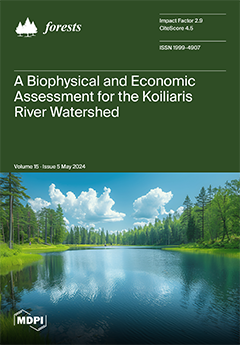
Monitoring Forest Dynamics and Conducting Restoration Assessment Using Multi-Source Earth Observation Data in Northern Andes, Colombia
Carlos Pedraza, Nicola Clerici, Marcelo Villa, Milton Romero, Adriana Sarmiento Dueñas, Dallan Beltrán Rojas, Paola Quintero, Harold Mauricio Martínez and Josef Kellndorfer.
Abstract
Examining the efficacy of current assessment methodologies for forest conservation and restoration initiatives to align with global and national agendas to combat deforestation and facilitate restoration efforts is necessary to identify efficient and robust approaches. The objective of this study is to understand forest dynamics (1996–2021) and assess restoration implementations at the Urra’s supplying basin hydroelectric reservoir in Colombia. The processing approach integrates optical and radar Earth Observation (EO) data from Sentinel-2 and Landsat for forest mapping and multitemporal forest change assessment (1996–2021), and a Sentinel-1 backscatter time-series analysis is conducted to assess the state of forest restoration implementations. The processing chain was scaled in a cloud-based environment using the Nebari and SEPPO software and the Python language. The results demonstrate an overall substantial decrease in forested areas in the 1996–2000 period (37,763 ha). An accuracy assessment of multi-temporal forest change maps showed a high precision in detecting deforestation events, while improvements are necessary for accurately representing nonforested areas. The forest restoration assessment suggests that the majority of the 270 evaluated plots are in the intermediate growth state (82.96%) compared to the reference data. This study underscores the need for robust and continuous monitoring systems that integrate ground truth data with EO techniques for enhanced accuracy and effectiveness in forest restoration and conservation endeavors.
Citación
Pedraza, C.; Clerici, N.; Villa, M.; Romero, M.; Dueñas, A.S.; Rojas, D.B.; Quintero, P.; Martínez, H.M.; Kellndorfer, J. Monitoring Forest Dynamics and Conducting Restoration Assessment Using Multi-Source Earth Observation Data in Northern Andes, Colombia.
Tags
forest management; forest restoration; Sentinel-1; Sentinel-2; Landsat; time series; cloud computing

Descargar documento
Forest carbon in Amazonia: the unrecognized contribution of indigenous territories and protected natural areas
Wayne Walker, Alessandro Baccini, Stephan Schwartzman, Sandra Ríoscg, María A. Oliveira-Miranda, Cicero Augusto, Milton Romero Ruiz, Carla Soria Arrascg, Beto Ricardo, Richard Smith, Chris Meye, Juan Carlos Jintiach & Edwin Vasquez Campos.
Abstract
Carbon sequestration is a widely acknowledged and increasingly valued function of tropical forest ecosystems; however, until recently, the information needed to assess the carbon storage capacity of Amazonian indigenous territories (ITs) and protected natural areas (PNAs) in a global context remained either lacking or out of reach. Here, as part of a novel north–south collaboration among Amazonian indigenous and non-governmental organization (NGO) networks, scientists and policy experts, we show that the nine-nation network of nearly 3000 ITs and PNAs stores more carbon above ground than all of the Democratic Republic of the Congo and Indonesia combined, and, despite the ostensibly secure status of these cornerstones of Amazon conservation, a conservative risk assessment considering only ongoing and planned development projects puts nearly 20% of this carbon at risk, encompassing an area of tropical forest larger than that found in Colombia, Ecuador and Peru combined. International recognition of and renewed investment in these globally vital landscapes are therefore critical to ensuring their continued contribution to maintaining cultural identity, ecosystem integrity and climate stability.
Citación
Wayne Walker, Alessandro Baccini, Stephan Schwartzman, Sandra Ríos, María A. Oliveira-Miranda, Cicero Augusto, Milton Romero Ruiz, Carla Soria Arrasco, Beto Ricardo, Richard Smith, Chris Meyer, Juan Carlos Jintiach & Edwin Vasquez Campos (2014): Forest carbon in Amazonia: the unrecognized contribution of indigenous territories and protected natural areas, Carbon Management, DOI: 10.1080/17583004.2014.990680
Tags
Amazonia, Indigenous territories, Protected natural areas, Aboveground forest carbon density.
Descargar documento
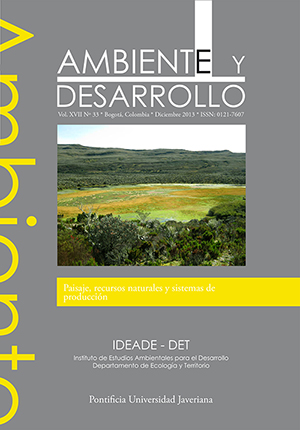
Diseño adaptativo de un paisaje agroindustrial. Una propuesta para la transformación agrícola de la altillanura colombiana
Germán-Ignacio Andrade-Pérez, Milton Romero, Juliana Delgado
Resumen
La dinámica de expansión de la agricultura industrial genera un riesgo para la biodiversidad y los servicios ecosistémicos de la Sabana tropical. Con el reconocimiento detallado de los ecosistemas y el diseño del paisaje, la Universidad de los Andes formuló para un grupo de empresarios, un modelo de emplazamiento de la agricultura, como transformación deseada según tres escenarios de exclusión incluyendo algunas tierras con potencial agronómico. Según la heterogeneidad ecológica encontrada, la voluntad de exclusión de la agricultura está entre un 30 y 50% de la superficie, lo cual podría generar un estándar para el sector, como aplicación de la política de gestión integral de la biodiversidad y servicios ecosistémicos y la adaptación al cambio climático basada en los ecosistemas. Palabras clave: ecología del paisaje, diseño en el paisaje, biodiversidad, agroindustria, servicios ecosistémicos, Orinoquia, altillanura. Palabras clave descriptores: ecología agrícola, sistemas productivos, aspectos ambientales, desarrollo sostenible, ecología del paisaje.
Abstract
The expansion process of the industrial agriculture creates a risk to biodiversity and the ecosystem services of the tropical savanna. With the mapping of ecosystems and, through a landscape design approach, Los Andes University drew up an agricultural siting model for a group of entrepreneurs. The desired transformation was discussed taking into account three scenarios for the exclusion of agriculture including some lands with agricultural potential. According to the ecological heterogeneity found, the decision of agricultural exclusion covers between 30 and 50% of the surface. The local exercise could generate a standard for the sector in the region, as anapplication of the policy for integrated management of biodiversity and ecosystem services, and ecosystem based adaptation to climate change.
Citación
Ambiente y Desarrollo, Bogotá (Colombia) Vol. XVII (33) 29-40, Julio-Diciembre 2013, ISSN: 0121-7607.
https://revistas.javeriana.edu.co/index.php/ambienteydesarrollo/article/view/7041
Tags
ecología del paisaje, diseño en el paisaje, biodiversidad, agroindustria, servicios ecosistémicos, Orinoquia, altillanura.
Descargar documento
An exploratory spatial analysis of illegal coca cultivation in Colombia using local indicators of spatial association and socioecological variables
Alexander Rincón Ruiz, Unai Pascual, Milton Romero.
Abstract
The cultivation of coca (Erythroxylon coca) by smallholders represents the first step in the world’s largest illegal agribusiness: cocaine. The literature on illicit crops generally considers the global and national factors that influence its expansion but little attention is paid to the local conditions where cultivation takes place. This study analyzes the economic, environmental, institutional and social factors associated with the existence of coca crops within municipalities in two different years (2001 and 2008). We do this from a regional perspective, by taking into account the particular factors that characterize the areas associated with coca municipalities and estimating the impacts of coca cultivation on natural ecosystems. For the proposed analysis we use Exploratory Spatial Data Analysis (ESDA) to visualize and describe the local spatial distributions and clusters, implementing the Local Indicators of Spatial Association (LISA) for the year 2001 and 2008. Our results show that no individual factor is exclusively associated with the coca areas; in fact, a group of common factors characterizes these regions. The analysis indicates that the expansion of coca cultivation has produced a process of deforestation mainly affecting humid tropical forested ecosystems.
Citación
Alexander Rincón Ruiz, Unai Pascual, Milton Romero. An exploratory spatial analysis of illegal coca cultivation in Colombia using local indicators of spatial association and socioecological variables. Ecological Indicators 34 (2013) 103–112.
https://www.sciencedirect.com/science/article/abs/pii/S1470160X13001702?via%3Dihub
Tags
Coca crops, Local indicators, Spatial analysis

Dirección: Calle 44a No 53 05 Bogotá, D.C. Colombia | Teléfono: (+57) 300 211 1915 |. E.mail: asarmiento@4delements.com